 During my senior year of high school, back in the Stone Age of 1986-87, a time when cash was king and debit cards were rare, I worked in what was then called a video rental store.
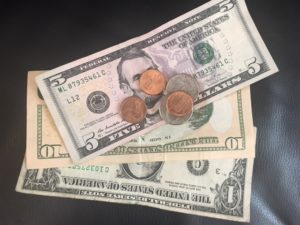
There I had a wonderful manager who taught me how to maintain a cash drawer. Bills were to face up and in the same direction with the top of the dead presidents’ heads to the left. Change was to be handed back in ascending order, counting up. If a customer gave a twenty for a $3.79 purchase, you’d start with the coins, then the picture of George Washington followed by Abraham Lincoln and then Alexander Hamilton (not a president, just a future musical inspiration) – all face up and in the same direction. After all, people wanted to put the cash back in their wallets neatly.
The “associates,” as we were called, counted off the change like this: “Okay, we have $3.79. Here’s four (handing back the coins), five (picture of George), ten (Abe) and twenty (Alex).”
“You’re showing respect for the customer,” my manager said, “You’re also showing respect for the business, your work, and the money itself. Don’t ever forget that.”
Thirty years later, I still haven’t forgotten. In fact, I think of it most every time a cashier hands me back change with the bills in random order, some upside down and facing every direction. Change rarely is counted back. Even at banks, money comes out of ATMs and from tellers in multiple directions.
Back at the video store, I prided myself on having a cash drawer that matched to the penny at the end of the night. This was in the heyday of video cassette rentals and I usually had more than $1,000 in cash in my drawer.
Now this might sound like the OCD ramblings of a middle-age man. “Dude, don’t you use credit and debit like everyone else? Use Apple pay. Who carries cash?”
Maybe. But this cavalier attitude toward cash is more a sign of a culture that no longer shows respect for the customer, business, work ethic, and the money itself. Customer service is a lost art. Nobody can handle cash – literally in the case of cashiers.
Those who benefit most from our consumer culture on steroids know that the greater the separation from your cash, the more you’ll spend. You’ll drop more with debit or credit since you can’t feel the cash leaving your hands. Cruise ships, theme parks, and cashless resorts understand this, giving customers charge cards and not accepting cash.
There’s even a movement by some in government to do away with cash altogether since, after all, cash is used in most illegal activities. Of course, if we eliminate cash we will leave an electronic trail on every deal, making everything taxable.
Such a move would take Americans further away from their cash, thus increasing consumer spending. Every financial guru encourages people to go on a cash diet. Spend only what you have on hand. Cut up plastic and pay with cash since it becomes more real. You feel the pain.
I learn a lot from standing in line at Chipotle. I’m fascinated by how so many teenagers have debit cards. Maybe they have jobs, though I haven’t seen a teen mow a lawn in 20 years. When our kids were a few years younger, we struggled to find babysitters. Teens are busy, though few seem to be working.
More likely, parents gave these kids debit cards, continually adding money. Thus teens rarely feel what it’s like to fork over cash – even of someone else’s money.
Since my teenage years working at the video store (RIP, Erol’s!), our national debt has soared to $20 trillion. Things that were fairly unusual in 1987 – car leasing, college loans, kitchen remodeling – have become standard operating procedure for many, who view consumer debt as the norm. If you can’t afford it, finance it. Sacrifice tomorrow for today.
Sure, income levels have hit a plateau or gone down. My college-educated video store manager once mentioned his $38,000 salary in 1987 – $82,000 in today’s dollars. There aren’t many retail managers making $82,000 today. (Again, RIP Erol’s!)
Even if incomes had risen, could they possibly keep up with the insatiable appetite for spending?
They might — if we spent more time thinking about how we handle cash.
 Distracted driving has become a big issue and with good reason. People think nothing of texting and talking while operating a 3-ton motor vehicle. No wonder it’s never been more dangerous to drive.
 Since committing to living lean, I’ve discovered a number of people who watch little or no television. It’s probably no coincidence that these usually are wildly successful and happy folks.
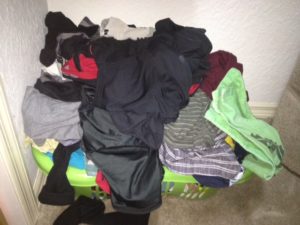 This isn’t about wearing dirty clothes, saving water and energy, or going nudist for a few weeks, though there’s something to be said for all of that. This is about leaning out your wardrobe and discovering the clothes you truly value.
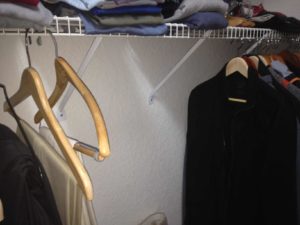 As I made my way to the bottom of that T-shirt pile looking for something to wear, I passed a few other shirts, well-worn wardrobe veterans. It was time to thank them for their service, as Marie Kondo recommends in her terrific book The Life-Changing Magic of Tidying Up, and take them either to Goodwill or the rag bin.
 As I write this, Hurricane Matthew is gaining strength in the Caribbean. Those of us who live in Florida know this drill well. We keep an eye on the news and update our hurricane plan if needed. Thankfully the storm usually weakens, moves offshore or takes a turn away from us.
 The hurricane never came and we returned home the following day. It was a valuable exercise, though, in realizing how little of what we have is important. Heck, even much of what we took at the time wouldn’t be necessary now that most everything is stored digitally.
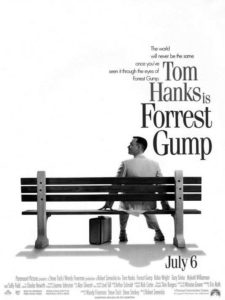
 Forrest Gump knew how to live lean. The guy didn’t own a car, preferring to run everywhere, and kept himself in top condition. He had a laser focus in all of his endeavors, from football to the military to Ping-Pong to entrepreneurial endeavors. Even after becoming a multimillionaire, he lived in his childhood home, wore the same clothes, and had the same small circle of friends, mostly just Jenny and Lt. Dan.
 That’s not to say, however, that we shouldn’t think like curators. The greatest museums display only a fraction of their vast holdings, the most noteworthy pieces. Sometimes artifacts are rotated in seasonally, but for the most part a museum’s holdings are warehoused and stored for research and preservation.
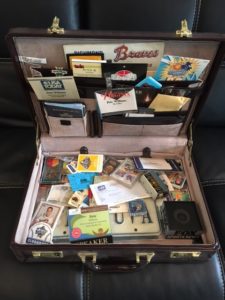
 I could have gone with a suitcase or a steamer trunk but that would not be living lean. Choosing a small suitcase – or briefcase – forces you to keep only what you’ll carry on the journey and nothing more. If you add to it, you must take something out. That’s why it’s best to be constantly curating.